
Most weekdays already ask a lot of us.
Work, messages, errands, dishes, appointments, maintenance, decisions — the small things that somehow keep multiplying. By dinner, your brain can still feel crowded even if the workday is technically over.
For me, a weekday dinner ritual helps break that rhythm.
Not because dinner needs to become an event. And definitely not because I want another thing to execute perfectly.
I just don’t want the majority of my life to feel like the part I’m getting through on the way to the weekend.
A few small choices can change the experience of an ordinary night much more than the time, money, or effort they require.
That is really the whole idea.
Make the ordinary feel deliberate
For me, one of the easiest ways to change the feeling of dinner is to eat outside when the weather makes sense.
After a day spent online and indoors, stepping outside helps me feel a little more present again. Even an apartment balcony can be enough.
That is my version of the ritual, though. Yours may have nothing to do with eating outside.
The point is not to recreate someone else’s dinner setup. It is to notice which small changes make an ordinary meal feel less automatic and more like something you chose to be present for.
I learned pretty quickly that if I wanted outdoor dinners to happen regularly, I had to make them easy.
So I keep a woven picnic basket near the back door with the things I reach for most: a washable tablecloth, cloth napkins, tea lights, a lighter, a small speaker, and a few basics we otherwise tend to forget.
The rest of the outdoor odds and ends live in a console nearby.
It looks nice enough to leave out, everything has somewhere to go, and the ritual does not depend on remembering ten separate things every night.
Let small things do more work
A few details can carry a surprising amount of the atmosphere.
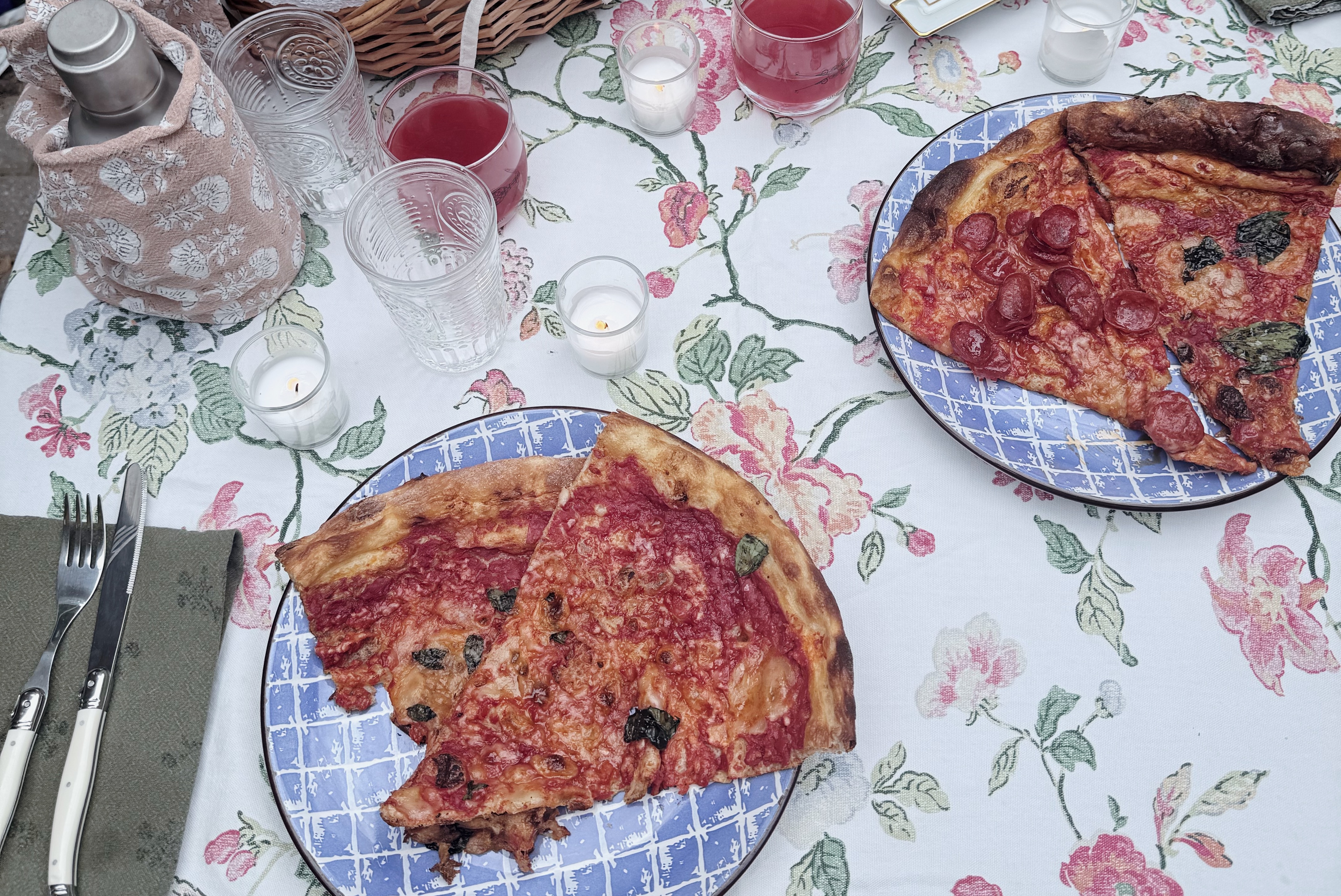
For me, a well-used floral tablecloth does a lot. So do cloth napkins.
Not precious ones. Nothing I am going to resent maintaining.
I have nicer linens I might pull out when people come over, but the weekday versions need to survive real life. They get washed. They get reused. I’m not worrying about them through dinner.
And to be candid, if my napkin makes it through dinner untouched, it may go straight back into rotation. My partner’s has significantly worse odds.
The same goes for dinnerware.
I want to like the things I use every day, but they also need to work every day. If I am reaching for a plate or bowl constantly, I want it to wear well and, ideally, go in the dishwasher.
Beautiful and practical are not opposing categories.
Lighting is another one of those small things that can change the whole experience quickly. Tea lights are inexpensive and make a table feel different almost immediately. Outside, I usually add string lights. Sometimes a small battery-powered lamp comes out too.
Inside, the specifics change, but the principle is the same: know what makes the room feel good to you, and make that version easy to access.
Build the ritual so it stays easy
This is the part that matters most if you actually want to keep doing it.
If the nice version of dinner requires fifteen extra steps, eventually you are going to stop.
I am constantly looking for the small points of friction that turn something enjoyable into a chore.
That is why the basket exists in the first place. It is why the things we tend to need live together. It is why I keep a small speaker there and why we already know a few playlists and artists we both like.
Nobody needs to turn dinner into a twenty-minute discussion about what should be playing.
The same thinking applies to whatever you tend to carry back and forth. If dinner needs ketchup, hot honey, dressing, or something else, I bring it out while we are finishing up in the kitchen.
Sometimes I pour what we need into a little bowl or ramekin.
Partly because it keeps us from getting up again.
Partly because, yes, I genuinely think a giant Heinz bottle in the middle of a pretty table changes the vibe.
Both things can be true.
The Ivy Standard
If a ritual matters to you, make it easy to repeat. Keep the things that support it together, close to where you use them, and contained in one intentional place. The fewer extra steps and decisions it takes, the more likely it is to become part of ordinary life — without creating a new source of clutter in the process.
The food doesn’t have to earn the table
A nice table does not have to correspond to a complicated dinner.
Some nights it is something you spent hours making. Some nights it is mac and cheese.
Either way, it is still your dinner, your evening, and part of your life.
The care you bring to the experience does not need to rise and fall based on how impressive the recipe is.
I think we sometimes get this backwards. We are happy to pull out the glasses, linens, serving pieces, and candles when the food is already special or when other people are coming over.
But an ordinary dinner can benefit just as much from a little atmosphere.
The food itself can stay exactly what it was going to be. What changes is the way you experience the time around it.
Stop saving everything for later
I understand having truly special things.
When I eventually have my Mimi’s china, I am not planning to eat off it every Tuesday.
But I also think “special occasion” can quietly expand until half the things we love are waiting for some future version of life.
A lot of us grew up with cabinets of glasses, dishes, or serving pieces that were too special to touch.
Then years later, those same households are trying to downsize and wondering what to do with all of it.
Some things are meant to be looked at. Some are meant to be used. Some can be both.
It is worth noticing how many things in your life are doing neither.
The things that make your home and your routines feel like yours should not exist primarily for other people to experience.
A little effort can change a lot
This is the part I keep coming back to.
A heightened experience does not necessarily require a proportionately heightened investment.
A tablecloth takes a minute. Tea lights take seconds. Putting dinner into a bowl you love costs nothing extra. Music can already be ready to go. A handful of small decisions can change the feeling of the evening without turning dinner into another project.
None of them is dramatic on its own.
Together, they can make an ordinary weeknight feel more intentional, more romantic, more like your own life rather than another block of time to move through.
And importantly, your version does not need to look like mine.
Maybe it is one candle. Maybe it is eating somewhere other than the couch. Maybe it is putting your phone away and using the plates you actually love. The value is in figuring out which small things noticeably change the experience for you — and making those easy enough to repeat.
The goal is not to make every night special.
It is to stop treating most of life as filler.
Ordinary life is not the waiting room for the good parts.